
Features, Data Accuracy and Pricing
SEO in 2026 is less about “one tool that does everything” and more about building a stack that matches how you win: research → execution → measurement → iteration. The annoying truth: every big tool is strong somewhere and weak somewhere else. The smart move is to pick based on use case, not brand hype.

What matters in 2026 (so you don’t buy the wrong tool)
Before comparing tools, here are the real decision criteria in 2026:
- Keyword intelligence quality
- Not just volume—intent, SERP features, difficulty reality, and keyword clustering.
- Link data accuracy + usefulness
- Freshness, spam detection, historical visibility, link context, and competitor mapping.
- Content + on-page workflow
- Can it help you brief, optimize, refresh, and track pages at scale?
- Technical SEO at scale
- Crawling, JavaScript rendering support, Core Web Vitals signals, and issue prioritization.
- Reporting + stakeholder-friendly outputs
- Can you turn work into dashboards, wins, and clarity?
- AI integration
- Can it help you think faster without hallucinating your strategy?
Semrush in 2026: The “all-in-one operations platform”
What Semrush is best at:
– Keyword research breadth: Huge database feel, tons of modifiers, strong SERP feature visibility.
– Competitive research: Great for mapping competitor traffic estimates, top pages, and content gaps.
– Content workflows: Helpful for briefs, topic clusters, and content optimization pipelines.
– Paid + SEO overlap: If you do PPC too, it’s convenient (competitive ads research, etc.).
– Reporting: Strong client-facing reports and campaign tracking.
Where it’s weaker:
– Link analysis depth vs specialists: Good, but not always the sharpest for deep forensic link work.
– “Everything” can feel noisy: Lots of features, not all equally useful.
– Traffic estimates can mislead: Useful directionally; don’t treat as gospel.
Best fit:
Agencies and teams that want one dashboard to run SEO operations: keyword research, audits, rank tracking, content planning, and reporting.
If you’re doing local SEO:
Semrush is solid for tracking, listings/citations (depending on region), and local visibility workflows, but you may still pair it with a dedicated local tool.
Ahrefs in 2026: The “competitive SEO intelligence + links powerhouse”
What Ahrefs is best at:
– Backlink analysis: Strong competitor backlink discovery and link intersect logic.
– Content exploration: Finding what performs, what earns links, and where competitors get traction.
– Site auditing: Good crawler and issue detection (though many still prefer dedicated crawlers).
– Keyword research quality: Very strong; often praised for practicality in competitive niches.
Where it’s weaker:
– Reporting polish vs Semrush: Still good, but Semrush tends to win on client-ready reporting workflows.
– Local SEO tooling: Not its core strength compared to local-first tools.
– “Done for you” content features: Some teams prefer other platforms for briefs/optimization.
Best fit:
SEOs who live in competitor analysis and link strategy—especially for B2B, SaaS, and editorial content.
Majestic in 2026: The “link graph specialist” (not a general SEO suite)
Majestic is the tool you bring in when you care about link graphs the way an investigator cares about fingerprints.
What Majestic is best at:
– Link graph depth + topical categorization: Useful for understanding link neighborhood relevance.
– Historical link analysis: Great when you’re auditing a domain’s link story over time.
– Prospecting + trust evaluation signals: Especially valuable if you understand how to interpret it.
Where it’s weaker:
– Keyword research: Not its job.
– Content workflows: Not its job.
– UI/learning curve: Not as friendly to beginners; more “analyst tool.”
Best fit:
Technical SEOs, link builders, and auditors who want deep link intelligence beyond what all-in-one suites provide.
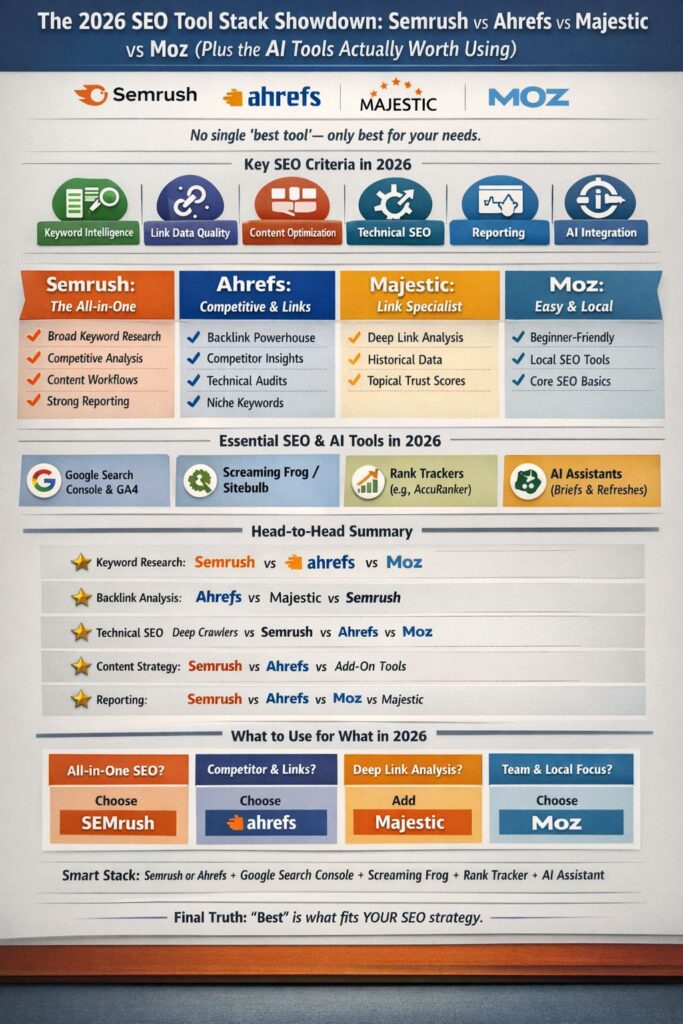
Moz in 2026: The “accessible SEO suite” with strong fundamentals
Moz tends to be the easiest to adopt across teams—less overwhelming, more guided.
What Moz is best at:
– Beginner-to-intermediate usability: Clear workflows for basics like rankings and on-page.
– Local SEO ecosystem: Moz has a long-standing footprint in local SEO tooling (via Moz Local).
– Core SEO metrics and tracking: Solid baseline suite, good for steady programs.
– Community + learning resources: Still one of the best “teach the team SEO” ecosystems.
Where it’s weaker:
– Depth for advanced competitive analysis: Often less deep than Ahrefs/Semrush for hardcore competitor work.
– Link database perception: Many advanced users prefer Ahrefs/Majestic for link-heavy strategies.
Best fit:
Teams that want clarity and consistency, especially where not everyone is an SEO specialist. Businesses prioritizing local SEO and foundational SEO hygiene.
The “other tools” you should consider in 2026 (because you probably need them)
The big four are not enough for a serious 2026 stack. Here’s what rounds it out:
1) Google tools (non-negotiable)
– Google Search Console: Truth source for queries, pages, indexing, and technical signals.
– Google Analytics (GA4): Behavioral + conversion reality check (messy, but necessary).
– PageSpeed Insights / CrUX: Performance signals and field data.
If you’re not using these, your SEO is basically “vibes-based marketing.”
2) Technical crawlers (the SEO mechanic’s toolbox)
– Screaming Frog: Deep crawling, custom extraction, automation, and audits.
– Sitebulb: More visual audit storytelling and prioritization.
– JetOctopus / OnCrawl / Deepcrawl (Lumar): For large sites and enterprise crawling.
These tools often outperform the built-in crawlers in all-in-one suites for deep technical work.
3) Rank tracking (more precise than suite trackers)
Depending on your needs:
– AccuRanker: Fast, accurate tracking and segmentation.
– STAT: Enterprise-level SERP tracking and data science workflows.
– SE Ranking: Cost-effective tracking + suite-like features.
If rankings are business-critical, specialized trackers can be worth it.
4) Content optimization (use carefully)
Surfer SEO / Clearscope / MarketMuse / Frase: Helpful for content refreshes and coverage.
But in 2026, don’t “write for tools.” Use these to check completeness, not to inflate word count.
5) Local SEO tools (when maps matter)
BrightLocal / Whitespark / Local Falcon: Tracking map pack performance, citations, geo-grid visibility.
If local is revenue, get a local-specific tool. Period.
AI tools for SEO in 2026: What they’re actually good for
AI is not your SEO strategy. It’s your strategy accelerator—if you keep it grounded.
Best uses of AI for SEO (practical and safe)
– Keyword clustering by intent (and turning clusters into page architecture)
– Content briefs (audiences, angles, questions, subtopics)
– Rewrite + refresh (improve clarity, structure, conversions, internal linking suggestions)
– SERP interpretation (summarize patterns: what formats win, what intent dominates)
– Schema drafting (with validation afterward)
– Automation: generating meta variants, FAQ candidates, internal link opportunities
Dangerous uses (where people get burned)
– “Auto-generate 200 pages” with no differentiation
– Writing medical/legal/financial advice content without review
– Publishing AI content without human editing and fact-checking
– Creating link outreach emails at scale that look like spam
AI + SEO tool examples (categories, not hype)
– AI writing assistants (for drafts + rewrites)
– AI content auditors (refresh recommendations based on performance + SERP patterns)
– AI internal linking tools
– AI programmatic SEO helpers (templates, entity coverage, QA)
The winning approach is: AI drafts, humans decide, tools validate.
Head-to-head summary (no bias, just reality)
Keyword research
– Best breadth + workflows: Semrush
– Best competitor-first practicality: Ahrefs
– Best “simple and solid”: Moz
– Not relevant: Majestic
Backlinks & link strategy
– Best everyday backlink intelligence: Ahrefs
– Best deep link forensics + topical trust analysis: Majestic
– Strong all-around but not top specialist: Semrush
– Good basics, less deep than top two: Moz
Technical SEO auditing
– Good built-in crawlers: Semrush, Ahrefs, Moz
– Best-in-class deep audits: Screaming Frog / Sitebulb / enterprise crawlers
– Majestic: not for this
Content strategy and scaling
– Best built-in content workflow + planning: Semrush
– Best for “what content wins” competitive insights: Ahrefs
– Moz: simpler but functional
– Add-on tools: Clearscope/Surfer/MarketMuse (use for completeness, not writing)
Reporting & stakeholder communication
– Most client-ready: Semrush
– Strong but more analyst-style: Ahrefs
– Simple and clear: Moz
– Majestic: niche reporting for link audits

What to use for what in 2026 (pick your stack)
Here’s the unbiased, practical recommendation framework.
If you want one tool to run most SEO operations
Choose Semrush Best when you need planning, tracking, reporting, and broad research in one place.
If your SEO growth depends on beating competitors and earning links
Choose Ahrefs
Best when competitor analysis and backlink strategy are central to winning.
If you do serious backlink audits, penalty recovery, or link quality analysis
Add Majestic
Use it as a specialist tool alongside Semrush or Ahrefs.
If you’re building a team-wide SEO culture (and local matters)
Choose Moz
Best when usability, fundamentals, and local SEO support are priorities.
The “smart default stack” for most serious teams
– Semrush or Ahrefs (choose based on your primary focus)
– Google Search Console (non-negotiable)
– Screaming Frog (technical depth)
– A rank tracker if rankings are mission-critical
– An AI assistant for briefs + refreshes (with human review)
Final call: no hype, just the clean truth
– There is no “best SEO tool” in 2026—only best for your workflow.
– Semrush is the strongest “SEO operations center.”
– Ahrefs is the strongest “competitive intelligence + links engine.”
– Majestic is the “link investigator’s microscope.”
– Moz is the “clean, team-friendly fundamentals suite,” especially useful for local.